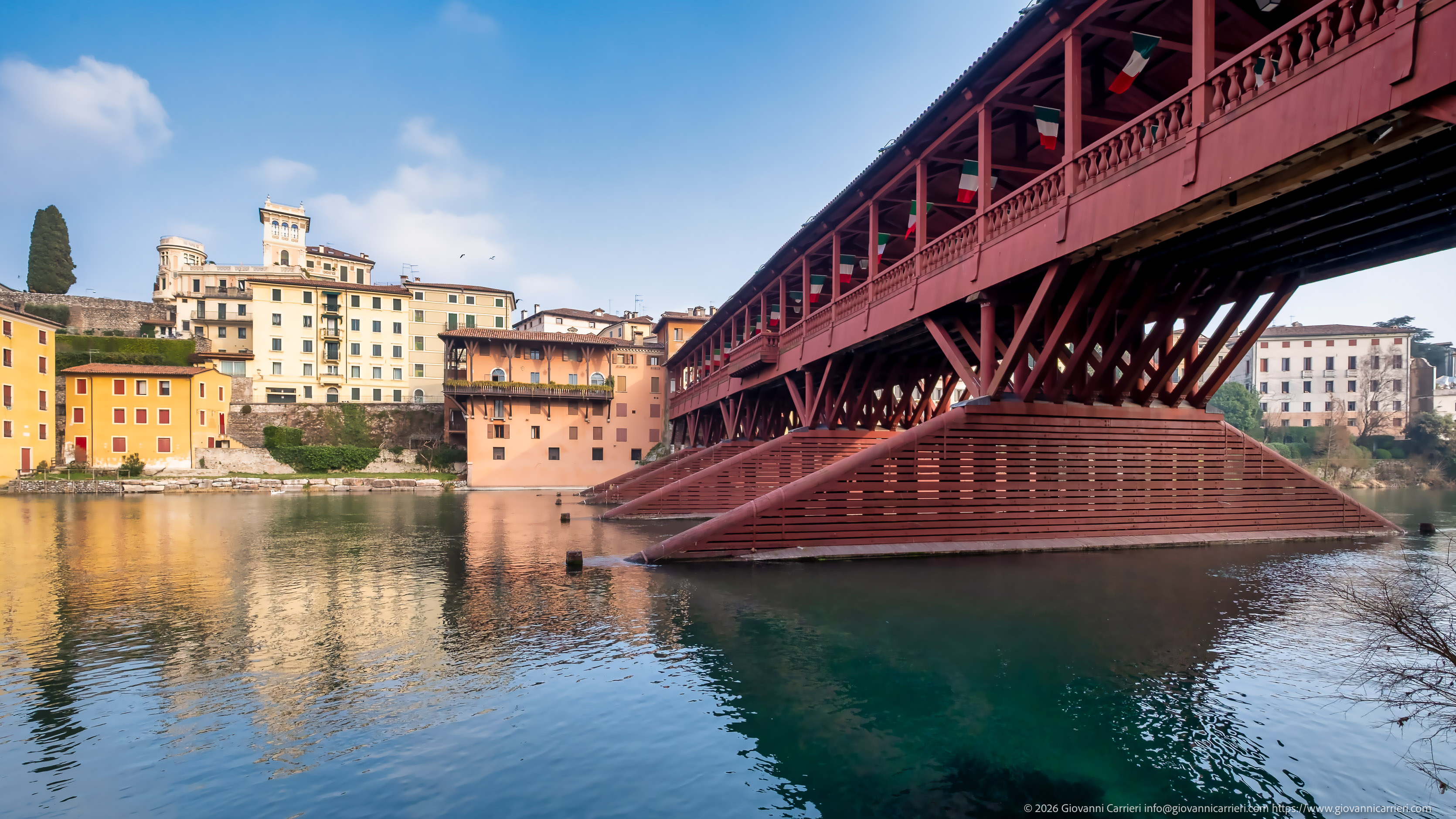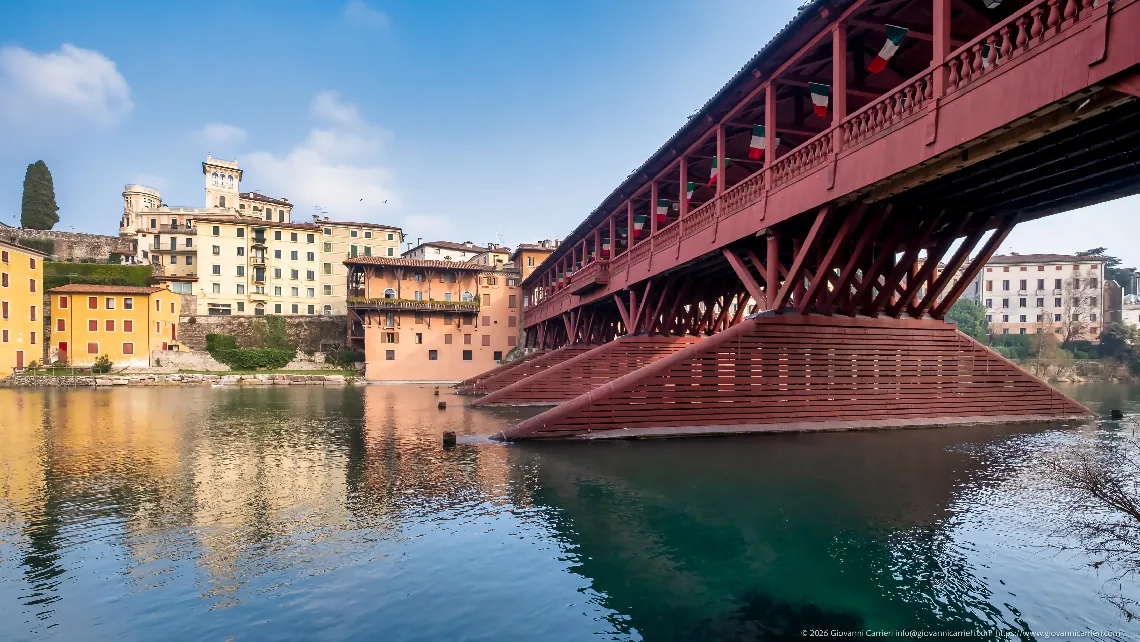
The timber structure and wedge-shaped piers of the Ponte degli Alpini seen from water level, Bassano del Grappa, Veneto, Italy
The frame is taken from the bank of the Brenta at water level and shows the Ponte Vecchio of Bassano del Grappa from the side that normally stays outside the general view: the soffit of the deck and its load-bearing apparatus. The close viewpoint makes legible the construction system devised by Andrea Palladio in 1569, which resolves the crossing through a sequence of timber trusses in larch and oak, braced by crossed diagonals and tied to the deck by vertical posts. In the foreground two of the four piers are visible: triangular cutwaters clad in continuous horizontal boarding, their points turned against the current. The wedge form serves a hydraulic purpose — deflecting the thrust of the current and the material it carries during the river's floods — and rests on a concrete base which, in the twentieth-century rebuildings, replaced the original foundations on piles driven into the riverbed. The timber carries the red-brown finish that characterises the whole structure. Along the parapet and beneath the roof slope hang the tricolour cloths associated with the ceremonies of the Alpini corps, to which the bridge has been dedicated since 1928 and which carried out its reconstruction in 1948, after the destruction suffered during the Second World War. On the left the built front of the western bank descends to the water, with façades in ochre and yellow, the projecting house with its timber loggia and the retaining wall of the embankment. Morning light rakes across the façades and is returned by the surface of the river, where the reflections shift from turquoise to orange.
Ponte degli Alpini, Ponte Vecchio Bassano, Bassano del Grappa, timber structure, truss, wedge-shaped piers, cutwaters, river Brenta, Andrea Palladio, Vicenza, Veneto, timber engineering, tricolour flags, Alpini, architectural detail, reflections on the river, covered bridge