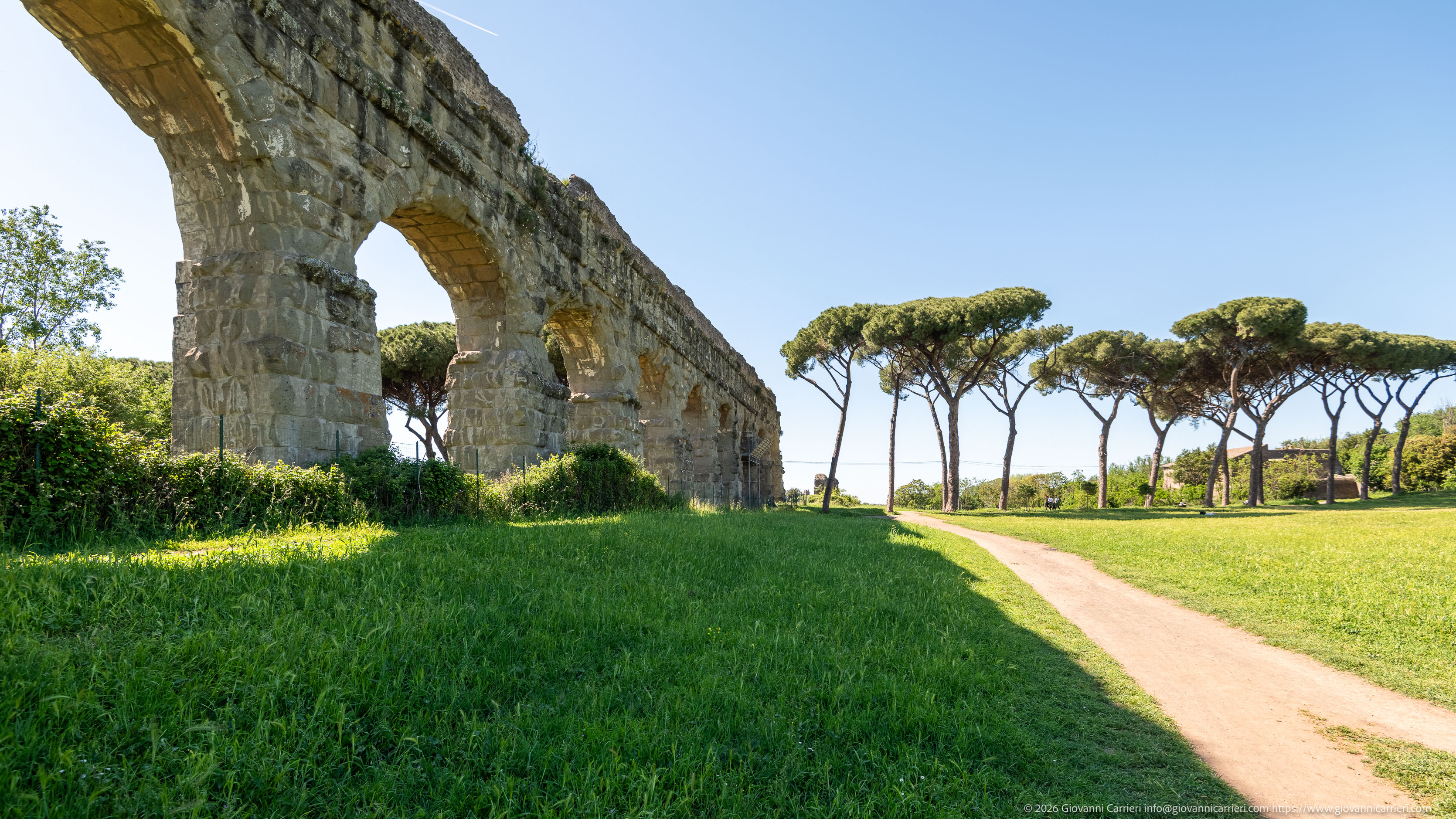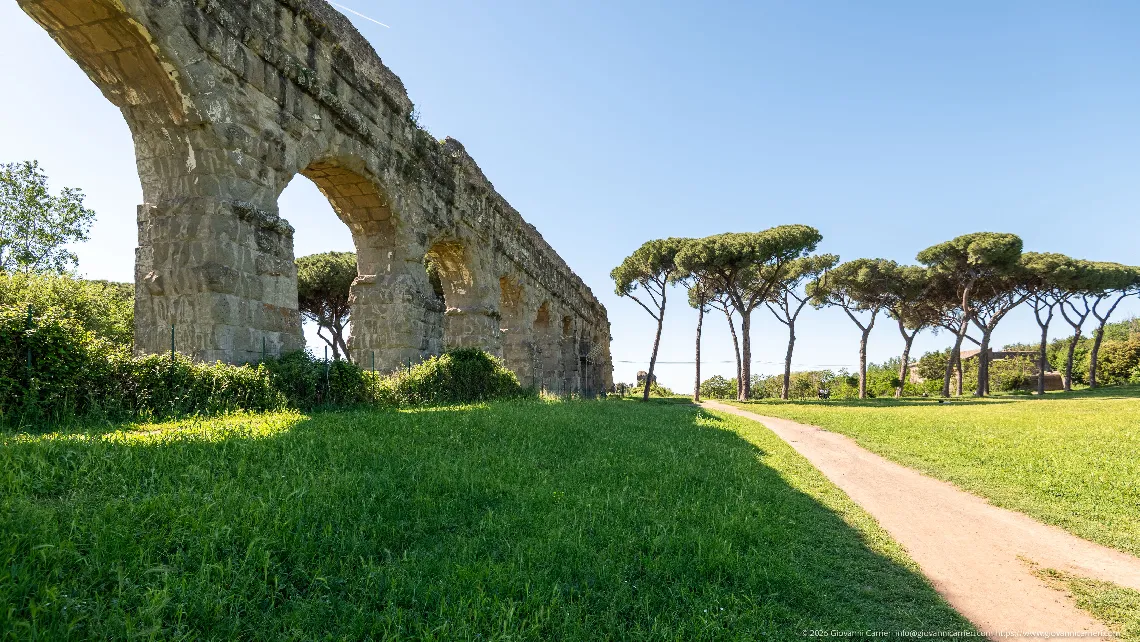
Park of the Aqueducts, Rome – Continuous Arcade of the Claudian Aqueduct Beside the Path Lined with Stone Pines, Spring Morning
Standing section of the Claudian Aqueduct preserved within the Parco degli Acquedotti, an area of about 240 hectares included in the Appia Antica Regional Park, in the fifth and seventh municipal districts of Rome. The structure was begun on the initiative of Caligula in AD 38 and inaugurated by Claudius on 1 August AD 52; it carried water from springs in the upper Aniene valley, near Subiaco, to the terminal distribution tank at Porta Maggiore, over a course of about 69 kilometres, roughly ten of which ran on substructures and arches in the final suburban stretch. The arches seen here are built in squared masonry of tuff and peperino blocks, with rectangular piers and voussoirs set radially; the continuous horizontal band along the top corresponds to the specus, the covered channel through which the water flowed, while the conduit of the Anio Novus originally ran above it and is largely lost in this sector. Gaps in the facing and brick repairs record the Flavian restorations and later consolidation work. Behind the aqueduct runs the row of stone pines that accompanies the park's unpaved path, an element of the agrarian and forest landscape of the Roman countryside established in large part between the nineteenth and twentieth centuries. Ground-level view, with raking side light from the east and long shadows across the meadow: the exposure can be placed in the morning, in the spring season, when the grass cover of the plateau reaches its fullest growth.
Claudian Aqueduct, Aqua Claudia, Park of the Aqueducts, Parco degli Acquedotti, Rome, Roman arches, Anio Novus, Roman aqueducts, Appia Antica Regional Park, squared masonry, tuff, peperino, specus, Claudian period, Flavian restorations, Roman countryside, stone pines, Pinus pinea, footpath, Roman archaeology, archaeological landscape, Porta Maggiore, spring, Lazio, Italy