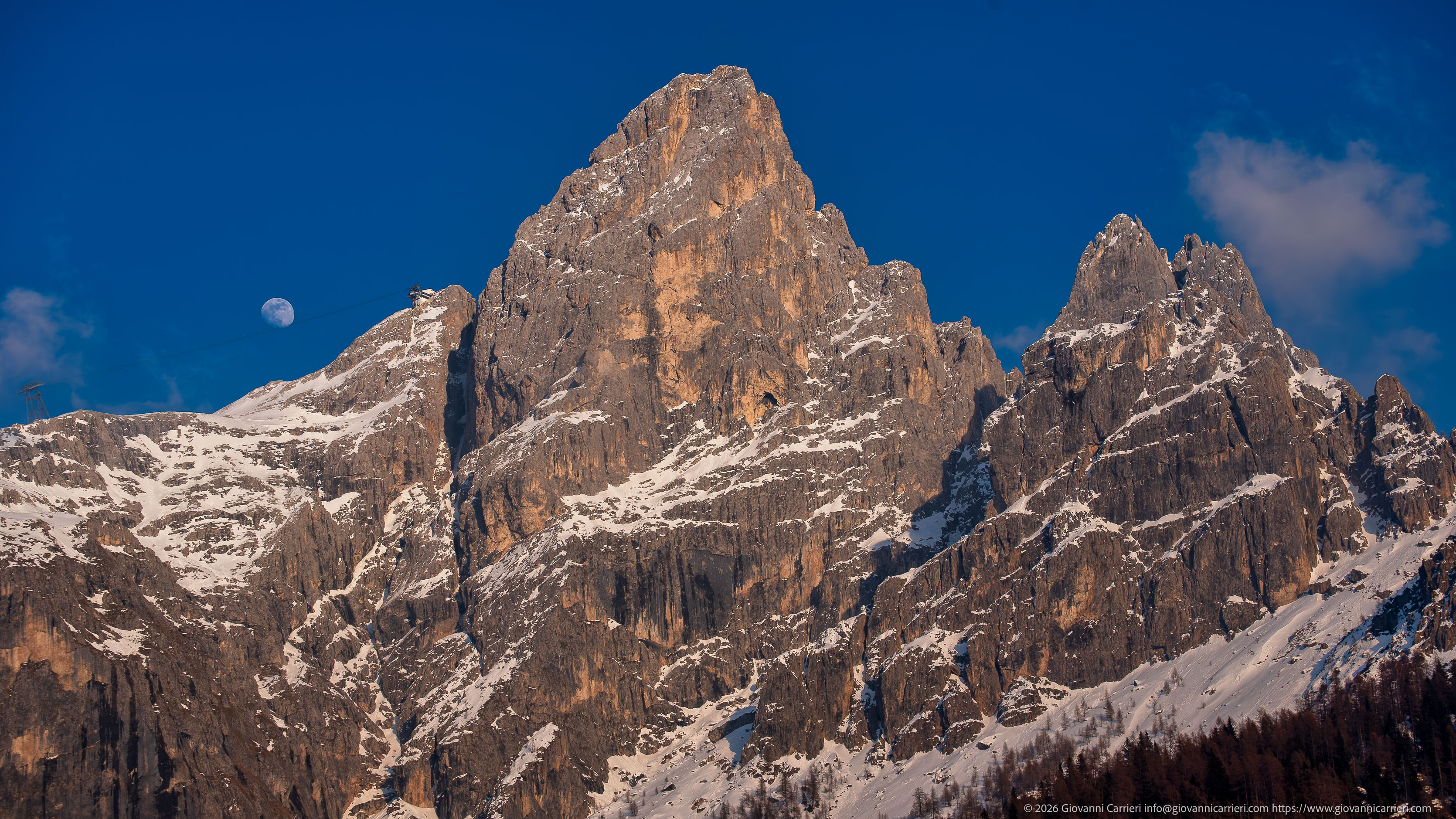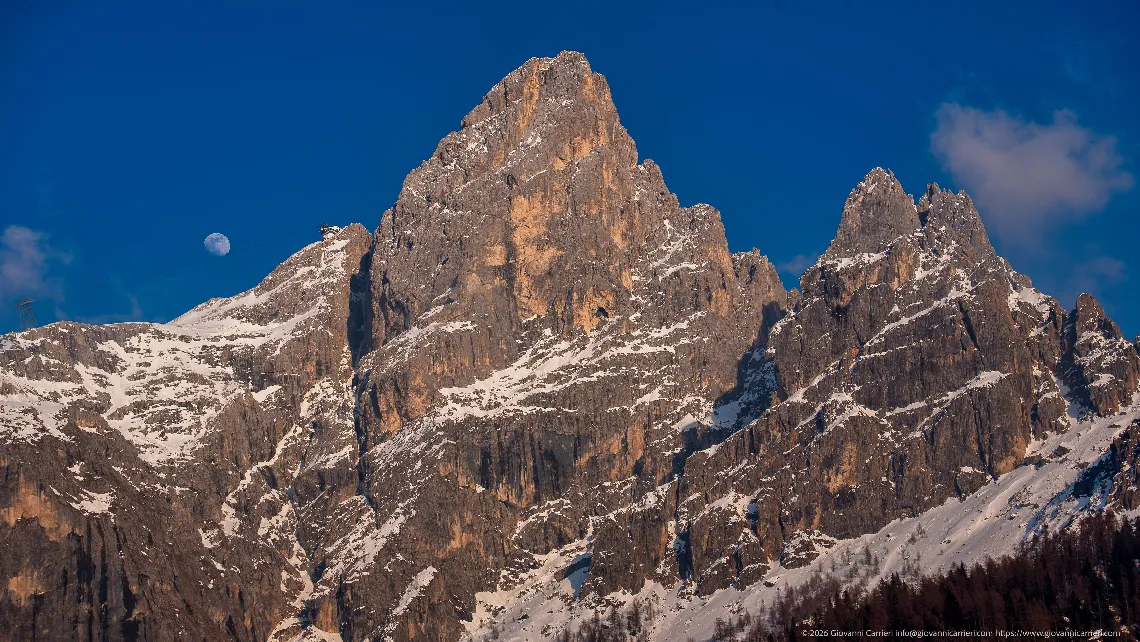
The rock face of Cima Rosetta in the Pala group seen from the valley floor at San Martino di Castrozza
From the valley floor at San Martino di Castrozza the slope rises without intermediate steps to the pyramidal summit that occupies the centre of the image. To the right a second relief, serrated into several points, closes the composition; to the left, on the lower shoulder, the station of a mountain lift can be made out and, further down along the ridge, a support pylon. The conifer wood takes up the lower edge and climbs the slope to the tree line, remaining the only element that allows the scale of the wall to be judged. The relief belongs to the Pala di San Martino group, a massif formed of carbonate rocks of Triassic origin. Its structure reads in two registers: the summit band, where the walls turn near-vertical and the rock is articulated into edges, towers and chimneys, and the middle band, where sub-horizontal ledges and scree gullies join the wall to the wooded slope. The gullies act as collectors: snow persists in them longer than on the exposed surfaces and traces their course. Light strikes the upper part of the wall and brings out the warm tones of the rock while the base stays in shadow: the sun is close to the horizon. The wood in the foreground consists of deciduous conifers with no needles, and snow occupies the ledges and the fans but not the exposed slopes, a condition consistent with a transitional season. On the right side some cloud gathers beyond the profile of the peaks.